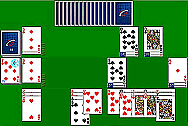
Canasta Overview
Canasta is a popular Rummy-type card game, played by 2 players (Rubl.com Canasta implementation). The goal is to beat the opponent player by scoring more points by melding cards (3 or more cards of the same suit), and making as many canastas as possible. A canasta is a meld of at least seven cards of the same rank. Canasta is played with 108 cards, consisting of two standard 52-card packs with four Jokers. Each player is dealt 15 cards. The rest of the deck is placed facedown to form the stock, and the top card of the stock is turned faceup and placed alongside the stock to start a discard pile. Like in all Rummy games the play procedure consist of taking cards from the closed stock or from the discard pile (in Canasta the player takes the whole pile), melding cards and discarding a card into a discard pile.
Number of Players
The basic game is for two players.
The Cards
Canasta is played with two standard 52 card packs plus four jokers (two from each pack), making 108 cards in all. They have the following point values for all the suits:


| 5 points each |


| 5 points each (only black Threes) |


| 10 points each |


| 20 points each |

| 50 points each |
The cards A, K, Q, J, 10, 9, 8, 7, 6, 5, 4 are called natural cards. All of the 2s and jokers are wild cards. Wild cards can be used during the game as substitutes for a natural card of any rank. The 3s are the bonus cards with the special functions depending on selected Canasta options.
Playing Canasta
The DealEach player is dealt 15 cards, and the rest of the canasta game cards are placed face-down on the table, to form the stock pile. The top card of the stock is taken off and placed face up next to the stock pile, to start the discard pile. If this first face-up card is wild or a red three, another card is turned and places on top of it, continuing until a card which is not a wild card or red three is turned up Any red 3s that were dealt will be automatically placed face-up next to the player's hand, and an equal number of cards will be drawn from the deck to replace them.
Game play Each player in turn performs one or more actions in the following order: 1. Draw the top card(s) from the closed stock (2 top cards by default option, 1 top card is a possible option - see options legend first "2") or take the discard pile if permitted. 2. Meld cards (if any meld is possible and subject to certain restrictions described below). 3. Discard (unless you go out by melding all cards left in hand).
How to Draw
You may always take the top cards from the closed stock - two or one - depending of the Game options - and add to your hand. If you draw a red Three, it is placed face up in front of you and another (replacement) card is drawn for you. (If a replacement card is again a red Three, the process of replacement is repeated until the replacement card is not a red Three.)
Instead of drawing from stock, you may draw the whole of the discard pile if you can immediately meld the upcard - either by adding it to one of your existing melds or by using it to start a new meld together with two or more matching cards from your hand (see Game options).
You may not take the discard pile if it is frozen. The discard is frozen:
- until you have made your initial meld
- when it contains a wild card - not nessessary on the top (or a red Three as the result of initial deal)
 If discard is frozen, you may only take it if you can immediately use the upcard to start a meld in conjunction with at least two matching natural cards (see Game options). Melds on the table do not help to take a frozen pile - only cards concealed in the player's hand. If the upcard is a black Three, you may not take it in any case; you need to draw from closed stock.
 . Red Threes freezes a discard pile for one move only, because it is impossible to meld Red Threes and the top card will be covered by the new discard card on the next move.
How to Meld To meld, you need a set of at least three cards of the same rank placed face up on the table (in front of your hand). Points are only scored for melds that are made before the hand ends. Jokers and deuces (twos) are wild cards that can be used as cards of any rank in a meld. However, all melds must contain at least two natural cards, no meld may contain more than three wild cards, and no meld may contain more wild cards than natural cards. A canasta is a meld of seven or more cards. A canasta must contain at least four natural cards. Red threes may not be melded or discarded (except in 'Red 3 Freezes' game option, where a red Three can be discarded). Black threes may only be melded when going out, in which case the meld must consist of a set of three or four black threes without wild cards. Meld examples:

| meld with 2 natural cards and 1 wild card |


| meld with 2 natural cards and 2 wild cards |


| natural canasta |


| mixed canasta |
Initial Meld Requirement
| Current Score | Required Meld Value |
| Less than 0 | 15 (any meld will do) |
| 0 to 1495 | 50 |
| 1500-2995 | 90 |
| 3000 or more | 120 |
How to Discard After drawing and optional melding, you complete your turn by discarding a card face up on the discard pile (unless you go out and have nothing left to discard). You may not discard a red Three unless the table was created with 'Red Three Freezes' game option. If you discard a black Three, you will freeze the discard for your opponent for one turn only. With 'Red Three Freezes' option, discarding a red Three also freezes the discard for your opponent for 1 turn only. If you discard a wild card, you will freeze the discard and it will remain frozen until taken.
Hand Finishing
Going Out A player "goes out" when no cards are left in her hand after a meld or discard. A player is not permitted to go out, however, unless there's at least one canasta (or at least two canastas, as in default game option). Upon going out, a player earns points as described below. In addition, the other player subtracts the point values of all cards that remain unmelded in the hand from his score. Values of all melds are also calculated, and players go on to the next hand unless one of the players has reached the winning total. If both players reach the winning total, the player with a higher total is the winner. Very rarely, the hand may end in a tie, and an extra tie-breaker hand will be played.
Ending Hand By Exhausting Stock If nobody goes out before the stock is exhausted, the play ends after the player who took the last stock card completes his turn unless opponent can pick up his discard. When there's no stock and discard cannot be picked up, the hand ends. The hand is scored as usual except that nobody earns a bonus for going out. If the last card drawn from the stock is a Red Three, the hand proceeds normally as above except no Red Three replacement occurs in this instance.
Canasta Scoring
Each card has a point value when it is melded. The same card values are subtracted from the other player's score for cards left in his hand when someone goes out. In addition to the point values of the melded cards, the following bonus points are scored at the end of a hand:
| At End of Hand | Bonus Points |
| Going out | 100 |
| Each red three (up to 3) | 100 |
| All four red threes | 800 |
| Each natural canasta | 500 |
| Each mixed canasta | 300 |
If a player did not manage to meld at all, each red threes counts as a negative 100 points bonus. If they have all four red threes and have not melded, they will receive a negative bonus of 800 points.
Game Options
Canasta can be played with various optional table settings:
- The number of points to play to can be set from 1,000 to 10,000 Default: 2,500 pts.
- The number of cards to draw from the closed stock can be set to 1 or 2 Default: 2 cards
- The number of canastas to go out with can be set to 1 or 2 Default: 2 canastas
- Allow (or disallow) the top card of the discard pile to go to melded canasta Default: disallow
- The top card of discard pile can only be picked up with 2 natural cards in hand. Yes or No Default: Yes.
- The Red Three freezes discard pile. Yes or No Default: No. If the 'Red Three Freezes' option is selected, discarding a red Three will freeze the discard for opponent for 1 turn only.
- The Wild canasta is allowed. Yes or No Default: No. If wild canasta is allowed, then at any point in the game 7 or more wild cards can be melded together in a separate wild card meld earning a 1,000 points.
-
Standard (default) canasta options at GameColony are listed in table listings as: 2-2-2
- The first number in the above short-hand notaion means: 2 cards to draw
- The second number means: 2 naturals required for taking a top card
- The third number: 2 canastas needed to go out Other examples of short-hand canasta options listings are:
- 2-2-2|3f|w (default options as above with 'Red Three Freezes' option and wild canasta option
- 2-0-1 (2 cards to draw, NO 2 naturals required for picking top card, 1 canasta to go out)
- 2-2-2 Tm (default game options with the top card of the discard pile is allowed to go to melded canasta)
Play Canasta Online. Canasta Tournaments